
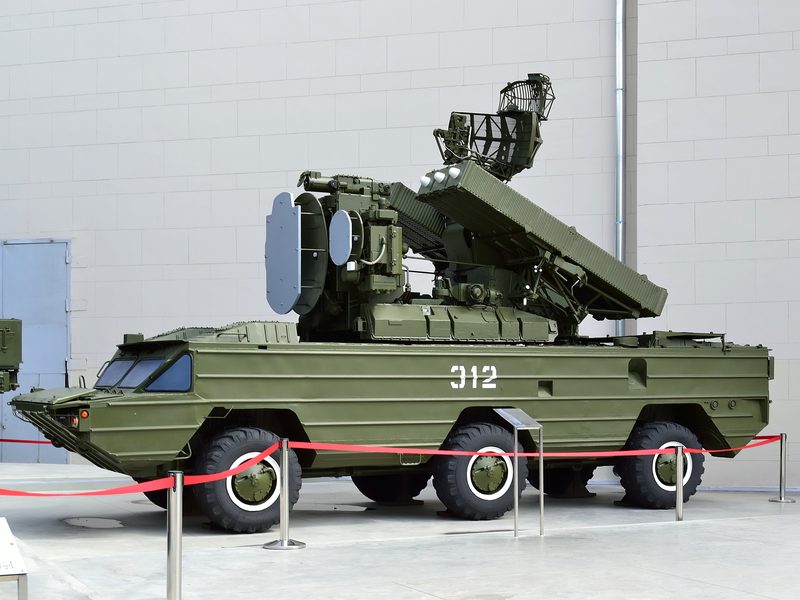
SA-8 Gecko
Mobile short-range SAM, amphibious, all on one vehicle
Compact, amphibious air-defence system from 1972: search radar, fire-control radar (Land Roll) and six missiles on one six-wheeled vehicle. That makes it self-contained for advancing units. Used by both sides in Ukraine, with Ukraine capturing several. Spread to Syria and Libya among others; the WEG notes proliferation to Hezbollah.
Dimensionsfor imagery analysis
- Vehicle
- TELAR 9A33 on BAZ-5937 6x6, amphibious
- L × W × H
- 9.14 × 2.75 × 4.20 m (radar mast stowed)
- Weight
- 17.5 t
- Missile (L × Ø)
- 9M33: 3.16 m × Ø 210 mm; 170 kg
- Dimension source
- Wikipedia; US Army TRADOC Worldwide Equipment Guide (ODIN)
General
- Role
- Short-range defence of moving forces
- In service
- 1972; Osa-AK 1975, Osa-AKM 1980
- Battery
- 4 combat vehicles + 2 reload vehicles
- Crew
- 5
- Users
- incl. Russia, Ukraine, Belarus, Syria, Libya, India; Hezbollah (WEG)
Weapon
- Missile
- 6 × 9M33M2/M3 in containers (Osa-AK/AKM)
- Guidance
- Radio command (RF CLOS)
- Range
- ≈ 5.4 – 8 NM (10–15 km, depending on version)
- Altitude
- ≈ 80 (over water) – 13,100 ft
- Speed
- ≈ 1.020 m/s
Radar & threat
- Radar
- Land Roll: search radar (H band, ≈ 11–16 NM) + tracking and guidance radar (J/I band)
- RWR
- Yes — Land Roll search and track signals
- Combat record
- Gulf War, Libya 2011, Syria, Nagorno-Karabakh 2020, Ukraine, India–Pakistan 2025
- Countermeasure
- Above ≈ 16,000 ft, ECM against command guidance, SEAD
- Threat level
- Medium — dated, but self-contained and mobile
News archive 4
Analysed reports from the RU Mil Tracker about this system, newest first. Archive since 2026-07-17.
-
«Российская ПВО и опыт Спецоперации: первые успехи» (Topwar: 'Russian air defence and the experience of the Special Operation: first successes')
In the first part of a three-part series, Topwar author Kirill Ryabov reviews the initial phase of Russian air defence in the war against Ukraine from February 2022. Ground Forces air defence carried the main load, with VKS air and missile defence units and naval systems also involved; the article lists the layered Ground Forces structure (S-300V4, Buk-M3,…
-
Ukraine scales up counter-measures against jet-powered Shaheds: small air defence missiles due in October, a new Nika missile heading into testing, Spys interceptor test and German funding for tens of thousands of interceptor drones
During German Chancellor Friedrich Merz's visit to Kyiv on 4 October, President Zelensky said Ukraine will start using small air defence missiles against Russian jet-powered drones in the second half of October. According to Militarnyi, he said there are several types, that they are not yet in use, and that production could be scaled up quickly if the inter…
-
Ukrainian Drone Worth Hundreds of Dollars Destroys russian Air Defense System Worth $10 Million (Video)
According to Defense Express, the Phoenix unit of Ukraine's Pomsta Brigade destroyed a Russian 9K33 Osa air defense system deep behind Russian lines using an FPV drone. The source, citing Ukraine's Ministry of Internal Affairs, estimates the drone's cost at several hundred dollars and the destroyed Osa system's value at roughly $10 million.
-
Ukraine develops RK-19 missile to sustain Soviet-era Osa-AKM (SA-8) air defence
Ukraine has developed the RK-19, a new surface-to-air missile intended to replace the dwindling stock of original 9M33-series missiles for the Soviet-era Osa-AKM system (NATO designation SA-8 Gecko). Per the sources, the missile was designed by the Luch Design Bureau, part of the state conglomerate Ukroboronprom. It was first referenced in an April 2026 vid…