
Hwasong-11A
North Korean short-range ballistic missile, used by Russia
North Korean solid-fuel short-range ballistic missile (SRBM) that closely resembles Russia's 9M723 (Iskander-M). It flies a flat, quasi-ballistic trajectory and can manoeuvre in the terminal phase, which shortens warning time and complicates interception. Russia has used it against Ukraine since late 2023 / early 2024; accuracy was initially mediocre but, according to Ukrainian intelligence, improved considerably afterwards. Not a VKS weapon in the strict sense, but a direct threat to the air defences (Patriot/SAMP/T) that also have to absorb the VKS air campaign.
Learn more in the AirDefense Academy →Dimensionsfor imagery analysis
- Missile (L × Ø, span)
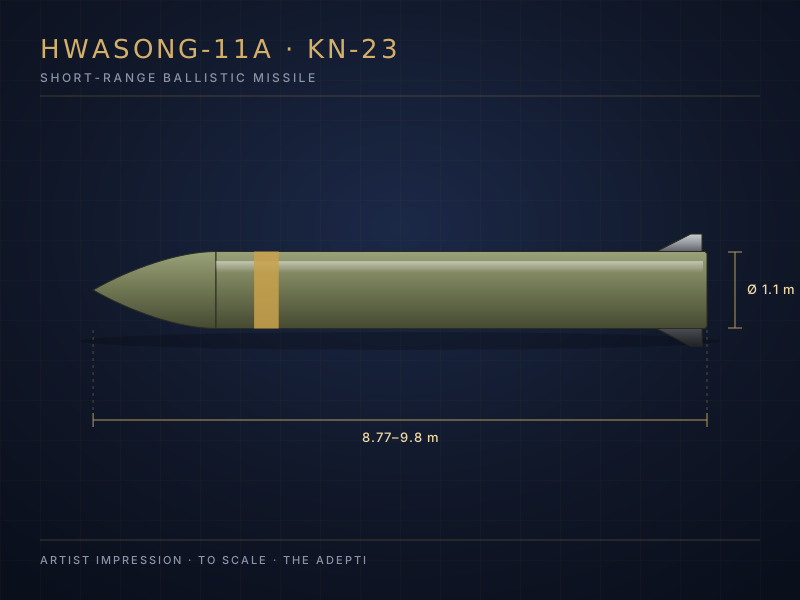
- 8.77 m (Wikipedia) / 9.8 m (WEG) × Ø 1.1 m; ≈ 3,415 kg
- Dimension source
- Wikipedia; WEG (ODIN)
General
- Type
- SRBM, solid fuel, quasi-ballistic
- Origin
- North Korea (DPRK); Russian use since late 2023 / early 2024
- Launcher
- Mobile wheeled TEL
- Warhead
- Conventional, ≈ 500 kg (open-source estimate)
Performance
- Max range
- ≈ 240–370 NM (450–690 km), depending on trajectory
- Apogee
- Typically ≈ 120,000–200,000 ft (37–60 km) — deliberately low and flat
- Guidance
- Inertial, probably with satellite-navigation updates; terminal manoeuvre
- Data point Sep 2026 (unverified)
- Two DPRK tests on 20 Sep 2026 reached ≈ 197,000–230,000 ft (60–70 km) at 440 and 590 km range according to Janes — possibly a new variant with a modified trajectory or warhead. Source: Defense Express via Janes, RU Mil Tracker e-20260923-s04 — single source, not independently confirmed
- Variant Hwasong-11Ma-1 (unverified)
- Version with a hypersonic warhead-glider, unveiled Oct 2025. Per Janes estimates ≈ 9.6 m long, 1.1 m diameter, ≈ 9.8 t launch mass; six-axle TEL carrying one missile. First test 20 Sep 2026 over ≈ 908 km (≈ 490 NM), with the glider covering most of the distance — note: this differs from the 440/590 km in the data point above; which test involved which variant is unclear. Transfer to Russia has not been established. Source: Defense Express, RU Mil Tracker e-20260929-s05 — single source
Threat
- Effect
- Fast, low attack on cities, energy infrastructure and air bases; little warning time
- Countermeasure
- Hit-to-kill interception (Patriot PAC-3, SAMP/T); passive protection and dispersal
- Threat level
- Very high — supplements Russia's Iskander arsenal
News archive 12
Analysed reports from the RU Mil Tracker about this system, newest first. Archive since 2026-07-17.
-
NYT: North Korea upgrades ballistic missiles and mass-produces attack drones with Russian help
According to a New York Times report (23 October 2026), relayed by Ukrainska Pravda and SFG Media, North Korea is continuing to upgrade its ballistic missiles and has begun mass-producing attack drones, largely thanks to its military cooperation with Russia. Russia is said to share its own developments with Pyongyang in exchange for soldiers, workers and we…
-
Russia strikes Ukraine overnight 16–17 October with Iskander-M/KN-23, Kh-22/32, Kalibr and 332 drones; no ballistic or Kh-22/32 missiles reported intercepted
On the night of 16–17 October Russia carried out a combined missile and drone attack on Ukraine, according to Ukraine's Air Force as reported by Ukrainska Pravda. It used Iskander-M/KN-23 ballistic missiles, Kh-22/32 cruise missiles, four sea-launched Kalibr cruise missiles and 332 Shahed (31 jet-powered) and Gerbera attack drones, plus S-8000 Banderol dron…
-
«ПВО ВСУ в ночь на субботу не смогла перехватить ни одной ракеты ОТРК «Искандер»» (Topwar: 'Ukrainian air defence failed to intercept a single Iskander missile on Saturday night')
Topwar (author Yevgenia Chernova) describes the Russian combined strike on Ukraine in the night to 17 October. The figures come from the Ukrainian Air Force. Russia reportedly used Iskander-M ballistic missiles, plus KN-23 missiles according to the Ukrainian side, as well as Kh-22/Kh-32 cruise missiles, four sea-launched Kalibr cruise missiles and 332 strik…
-
Russia fires 39 ballistic-trajectory missiles and 128 drones, 77 of them jet-powered, at Ukraine overnight on 13-14 October: three killed in Kyiv, power cut in five districts
Russia carried out a massed combined strike on Ukraine between 18:00 on 13 October and the morning of 14 October, according to the Ukrainian Air Force. It says its radio-technical troops tracked 167 air-attack assets. These were 39 missiles flying ballistic trajectories, listed as Iskander-M, KN-23, S-400, Zircon and Oniks and launched from Kursk, Bryansk,…
-
«Понад 52 тисячі цілей за місяць: Повітряні Сили оприлюднили результати роботи у вересні» (ArmyInform: More than 52,000 targets in a month: the Air Force publishes its September results)
ArmyInform, the news agency of the Ukrainian Ministry of Defence, reports the Ukrainian Air Force's results for September 2026, published on 10 October. According to the Air Force, Ukraine's Defence Forces destroyed more than 4,700 aerial targets during the month and also neutralised more than 48,000 tactical-level UAVs, giving the headline total of over 52…
-
Hwasong-11Ma-1 Details Reveal 9.8-Ton "Classical" Hypersonic Missile, Key Question Is Whether Pyongyang Transfers It to russia
Defense Express reports new details on North Korea's Hwasong-11Ma-1, which Pyongyang first presented in October 2025 and then waited almost a year to launch. It was first tested on 20 September 2026 over 908 km, with the warhead-glider covering most of the distance. Citing Janes estimates, the article gives a body length of 9.6 m, a diameter of 1.1 m and a…
-
Russia strikes Kyiv with drones by day, then Zircon and Iskander-M missiles overnight; Zelensky claims 60% of ballistic missiles intercepted
Over roughly 24 hours on 23–24 September 2026, Russia struck Kyiv first with a daytime drone attack and then overnight with a combined missile and drone strike. On the morning of 23 September, Kyiv Mayor Vitali Klitschko reported drone hits on petrol stations in Holosiivskyi and Darnytskyi districts, a transport infrastructure facility, a four-storey busine…
-
Unknown North Korean KN-23 Variant Can Reach 60–70 km Altitude, Posing New Challenge for Patriot Systems
Defense Express analyst Ivan Kyrychevskyi, citing Janes, reports that North Korea launched two KN-23 ballistic missiles on 20 September 2026. The first flew 440 km and reached an altitude of about 60 km; the second flew 590 km and peaked at about 70 km. Janes assessed that this may be a new KN-23 variant, possibly with a changed flight trajectory or warhead.
-
North Korea has fired around 150 ballistic missiles at Ukraine and is learning from each strike, Ukrainian intelligence says
According to Euromaidan Press, roughly 150 North Korean KN-23 and KN-24 ballistic missiles have been fired by Russia at Ukraine since late 2023 (an estimate). Ukraine's military intelligence service HUR, announcing this via social media, states that each strike gives Pyongyang combat data that has sharpened its weapons. Wartime use in Ukraine thus effective…
-
Russia ramps up ballistic strikes on Ukraine using converted S-400 missiles
Russia has driven its ballistic missile campaign against Ukraine to record intensity through mass use of the RM48U — a converted training/target missile originally built on decommissioned S-400 interceptor missiles (48N6DM family) and used to train air-defence crews — according to a Reuters exclusive based on official Ukrainian data. The missiles are now fi…
-
Ukrainian Drone Takes Out Rare North Korean Type-75 Rocket Launcher
Ukraine's 40th Brigade destroyed a North Korean-supplied Type-75 rocket launcher with a strike drone, according to Defense Express, which cites video released by the brigade. The Type-75 is a 107mm, 12-tube multiple rocket launcher — a North Korean copy of the Chinese Type 63, itself derived from the Soviet BM-14 design of the 1960s. Each unguided rocket we…
-
Ukrainian intelligence: Russia to test new ballistic missile with ~800 km range, possibly by striking western Ukraine
Ukraine's military intelligence directorate (HUR) says Russia is preparing final tests of a new ballistic missile with a range of up to roughly 800 kilometers before the end of 2026. The statement was made by Major General Vadym Skibitskyi, deputy head of the HUR, at a session of the Ukraine-NATO Interparliamentary Council on 8 September 2026. The HUR attri…