
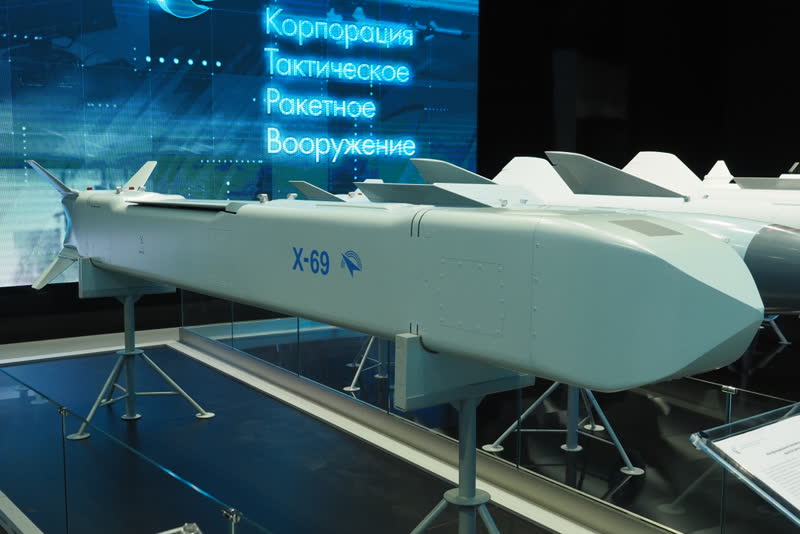
Kh-69
New low-observable air-to-surface cruise missile for the Su-34, Su-35 and Su-57
The VKS's newest tactical cruise missile, designed by MKB Raduga and first shown in 2022; the export version is called the Kh-59MK2. Its flat, angular low-observable body fits the Su-57's internal weapons bays, and it flies very low on a turbofan — reportedly down to ≈ 20 m above the ground. Used against Ukraine since February 2024, first against power plants (the Trypilska plant near Kyiv was destroyed in April 2024, with Kh-69 debris found on site), later also with a cluster warhead. Ukraine can intercept it: in October 2024 a cluster version for the first time, and in October 2025 Air Command East downed one with a cheap laser-guided APKWS rocket. In 2026 Ukrainian officials link Kh-59/69 strikes to both Su-34s and Su-57s (including Dnipro, 3 May 2026), and according to Militarnyi Kh-59/69s hit the grain bulk carrier GOLDEN LEO in the Black Sea on 19 July 2026.
Learn more in the AirDefense Academy →Dimensionsfor imagery analysis
- Missile (L × Ø, span)
- 4.19 m × Ø 0.42 m, span 2.45 m (wings deployed); 770–800 kg
- Dimension source
- Wikipedia; WEG (ODIN)
General
- Type
- Subsonic tactical air-to-surface cruise missile with low radar signature (turbofan)
- Carriers
- Su-34, Su-35, Su-30, Su-57 (internal); also MiG-29K/MiG-35 per the manufacturer
- Origin
- MKB Raduga / Tactical Missiles Corporation; shown Aug 2022, exported as Kh-59MK2
- Use
- Ukraine since Feb 2024: energy (Trypilska, Apr 2024), cities (Dnipro, May 2026), shipping (GOLDEN LEO, Jul 2026)
Performance
- Max range
- ≥ ≈ 215 NM (400 km)
- Speed
- ≈ 1,000 km/h (subsonic)
- Flight altitude
- Very low, reportedly down to ≈ 65 ft (20 m)
- Warhead
- ≈ 300 kg, penetrating or cluster; mass ≈ 800 kg
- Guidance
- Inertial + satellite navigation + optical (contrast) terminal seeker
Threat
- Effect
- Precision strike on energy, cities and ships, launched outside SAM range and arriving low
- Countermeasure
- Interceptable by SAMs and even cheap APKWS rockets (Oct 2025); early detection of the launch aircraft
- Threat level
- High — harder to detect than the Kh-59M; makes the Su-57 an active stand-off carrier
News archive 3
Analysed reports from the RU Mil Tracker about this system, newest first. Archive since 2026-07-17.
-
«Три ракети та 112 дронів знищили сили ППО під час нічної атаки» (ArmyInform: 'Air defence destroys three missiles and 112 drones during overnight attack')
ArmyInform, citing the Ukrainian Air Force, reports that during the night of 26 October (from 18:00 on 25 October) Russia attacked with missiles and strike drones. According to the Air Force, Russia launched one Kh-31P anti-radiation missile and three Kh-59/69 guided air-launched missiles from occupied areas of Zaporizhzhia and Kherson oblasts, plus 140 Sha…
-
«Понад 52 тисячі цілей за місяць: Повітряні Сили оприлюднили результати роботи у вересні» (ArmyInform: More than 52,000 targets in a month: the Air Force publishes its September results)
ArmyInform, the news agency of the Ukrainian Ministry of Defence, reports the Ukrainian Air Force's results for September 2026, published on 10 October. According to the Air Force, Ukraine's Defence Forces destroyed more than 4,700 aerial targets during the month and also neutralised more than 48,000 tactical-level UAVs, giving the headline total of over 52…
-
Ukraine hits two Russian missile-component plants in two nights: Almaz-Antey's Iskra in Ulyanovsk (Kh-59, Pantsir parts) and the Azov Optical-Mechanical Plant, which leaked files tie to at least seven missile programs including Kh-101 and Oreshnik
Ukrainian long-range drones struck JSC NPP 'Iskra Plant' in Ulyanovsk overnight on 24–25 September 2026, as part of a wider drone barrage on Russia. The plant belongs to the Almaz-Antey defence conglomerate and makes semiconductor devices, microwave components and electronics. According to Militarnyi and an identification by the independent Russian outlet A…