
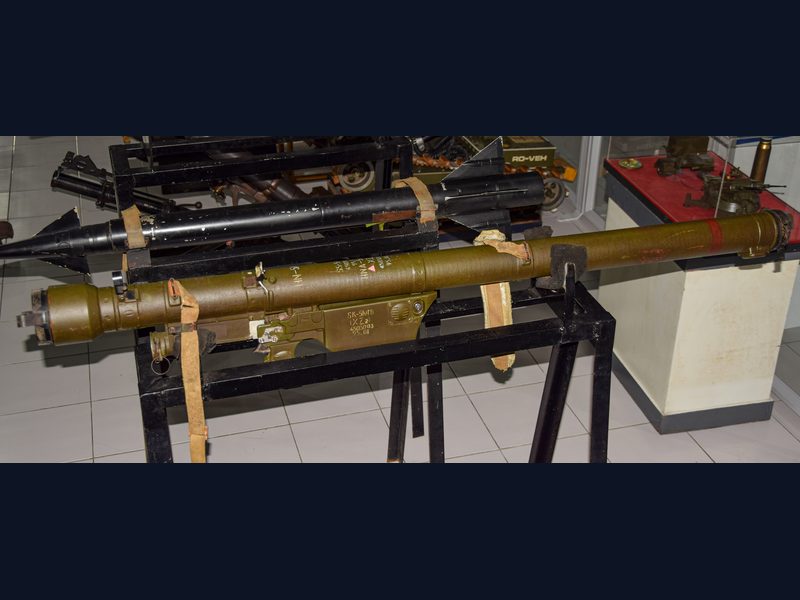
MANPADS
HN-5 family
Hongying-5 (CH-SA-3)
Medium
CN
Chinese man-portable air-defence missile, first generation (Strela-2 copy)
Chinese reverse-engineered Soviet Strela-2 (SA-7), developed 1973–1982. SAST's HN-5A is not an upgrade but a parallel development with a larger warhead, higher speed and a thermoelectrically cooled seeker (≈ Strela-2M); the HN-5B uses Strela-3 technology and the HN-5C is an eight-round vehicle system. Widely spread via Pakistan (Anza Mk-I) and the Afghan mujahideen. Succeeded by the QW-1 and HN-6.
Learn more in the AirDefense Academy →Dimensionsfor imagery analysis
- Missile (L × Ø, span)
- HN-5A: 1.44–1.46 m × Ø 72 mm; 10.2 kg
- System
- 16 kg ready to fire
- Dimension source
- Wikipedia; WEG (ODIN)
General
- Role
- Last layer, man-portable
- Manufacturer
- Chinese state industry; HN-5A by SAST
- In service
- HN-5 certified 1983, HN-5A 1984, HN-5B shown 1990
- Variants
- HN-5, HN-5A (≈ Strela-2M), HN-5B (Strela-3 technology), HN-5C (4x4 vehicle, 8 missiles), HQ-5C (export)
- Derivatives
- Anza Mk-I (PK); local production in North Korea
- Users
- incl. China, Pakistan, Iran, Iraq, Myanmar, Thailand, Bangladesh, North Korea, Bolivia, Ecuador; United Wa State Army
Weapon (HN-5A)
- Guidance
- Infrared, thermoelectrically cooled seeker with filter
- Range
- ≈ 0.4 – 2.4 NM (0.8–4.4 km)
- Altitude
- ≈ 160 – 8,200 ft (50–2,500 m)
- Speed
- 500 m/s
- Warhead
- 1.17 kg (0.5 kg filling), impact fuze
- Missile
- 10.2 kg, length 1.46 m
Warning & threat
- RWR
- No — passive; only a MAWS sees the launch
- Countermeasure
- Altitude, flares (effective), steep approach
- Threat level
- Medium — outdated, but widely available
News archive 0
Analysed reports from the RU Mil Tracker about this system, newest first. Archive since 2026-07-17.
No reports linked yet.