
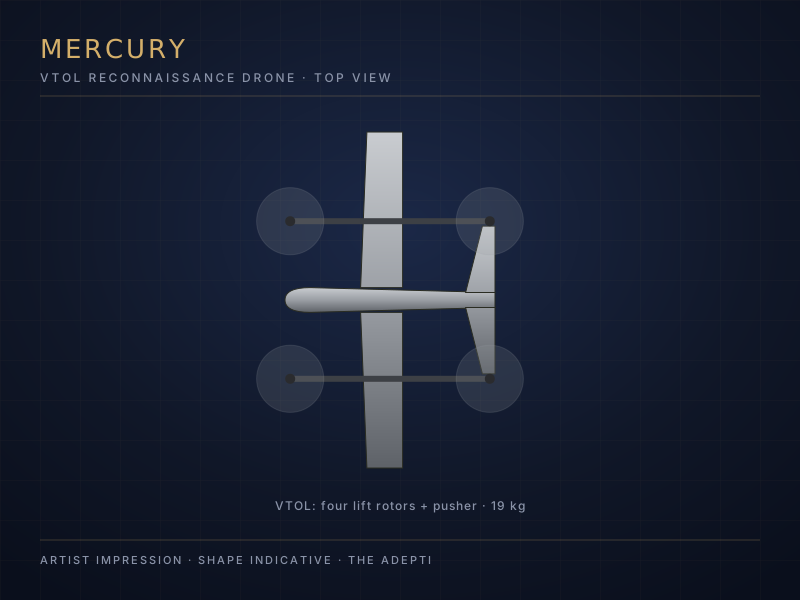
Mercury (ANT)
Tactical reconnaissance, target detection and fire correction with layered, jam-resistant links
A vertical take-off reconnaissance drone from Ukraine's ANT (Aviation New Technologies), first shown in June 2025 and codified by Ukraine's Ministry of Defence. The version presented in October 2026 flies further and longer and is designed around Russian jamming and the loss of GNSS: a second FHSS link, navigation without satellites and a radio-silent mode. Figures are developer claims and partly differ from those given at the 2025 launch.
Learn more in the Drone Academy →Key data
- Manufacturer
- ANT — Aviation New Technologies (Ukraine)
- Take-off weight
- 19 kg (was 13 kg)
- Range
- 250 km, up to 300 km operationally (was 170 km)
- Endurance
- 4 hours nominal, up to 5 hours in practice (was 2.5 hours)
- Ceiling / speed
- 4,000 m; cruise 90 km/h, top 126 km/h
- Sensors
- Day camera up to 210x zoom + 1280 × 1024 thermal; vehicles to ~20 km, people to ~15 km (claim)
EW resistance
- Links
- Primary 5.8 GHz; backup 433 MHz with frequency hopping (FHSS)
- Navigation
- GPS/GLONASS, inertial navigation without satellites and radio beacons; autonomous route flight, radio-silent mode, automatic return
- Deployment
- VTOL from 5 × 5 m; a set of two drones + ground station set up in 15 min by two operators
Relevance
- Why it matters
- Shows how ISR drones are redesigned around EW: layered links, FHSS and GNSS-free navigation — the same logic seen on Russian drones
- Source
- Militarnyi (20 Oct 2026), RU Mil Tracker e-20261021-07; developer claims
- See also
- The Orlan-10 and EW: jamming & GPS spoofing cards
News archive 1
Analysed reports from the RU Mil Tracker about this system, newest first. Archive since 2026-07-17.
-
Ukraine's ANT upgrades Mercury VTOL reconnaissance UAS: up to 300 km range, 4-5 h endurance and FHSS backup link against Russian EW
Ukrainian company ANT (Aviation New Technologies) has unveiled an upgraded version of its Mercury reconnaissance UAS, Militarnyi reports. According to the developer, maximum altitude rises from 3,000 to 4,000 m, rated endurance from 2.5 to 4 hours (up to five in practice), and maximum range from 170 to 250 km, reaching up to 300 km under operational conditi…