
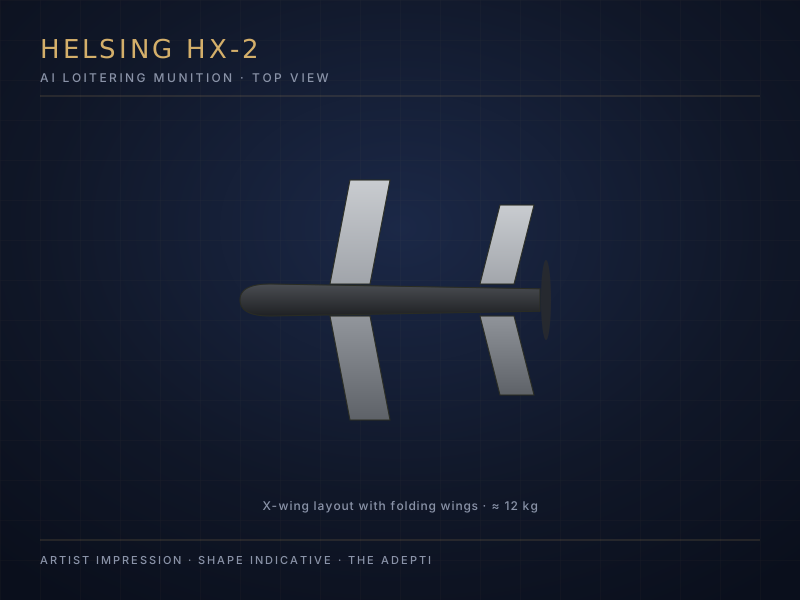
Helsing HX-2
Strike drone that searches for and tracks targets on board, even when its link and satellite navigation are jammed
A loitering munition from Germany's Helsing, unveiled in late 2024. It navigates with AI and stored map data without GPS and can search for and track targets on board without a continuous datalink; a human stays involved in critical decisions. In February 2025 Helsing announced 6,000 HX-2s for Ukraine. According to a Janes report (Oct 2026), Ukrainian interest is growing where Starlink is unavailable. Figures differ between sources and have not been independently confirmed.
Learn more in the Drone Academy →Key data
- Manufacturer
- Helsing (Germany); built at the Resilience Factory, initially > 1,000 a month
- Mass / payload
- ~12 kg (Topwar); payload up to ~5 kg (Wikipedia)
- Range
- up to ~100 km
- Speed
- ~220 km/h (Topwar) to ~250 km/h (Wikipedia)
- Navigation
- AI + stored map data, without GPS; one pilot with a laptop can control several drones
Relevance
- Use in Ukraine
- Per an industry source (Janes, 16 Oct 2026) several thousand missions since Oct 2025, including around Donetsk; Helsing claims a 100% hit rate at the Sentinel Strike Challenge (Portugal, Sep–Oct 2026), including against moving targets under GNSS jamming
- Russian reading
- Topwar: such drones cannot be stopped by jamming their link and are harder to detect from their own emissions; they remain vulnerable to radar, EO sensors, missiles and guns
- Related
- HF-1 (cheaper version with a plywood fuselage), 4,000 funded by Germany for Ukraine
- Source
- Topwar (21 Oct 2026), RU Mil Tracker e-20261021-s05; Wikipedia (Helsing). Company and Russian claims, not independently confirmed
- See also
- The Lancet and Lupinis-10 (TFL-1) cards
News archive 4
Analysed reports from the RU Mil Tracker about this system, newest first. Archive since 2026-07-17.
-
Helsing unveils AD-2 'Ambush' counter-UAS interceptor missile (engagement altitude above 9 km) as part of its Contra air-defence suite, aimed at Russia's fast jet-powered Geran drones
German defence company Helsing presented its Contra air-defence offering on 26 October 2026: two new interceptor missiles plus AI software that automatically calculates the order and distance of intercepts. According to Defense News, the company says Contra can down fast attack drones for under $100,000 per shot; it is still in testing, is expected to be ma…
-
«Немецкий HX-2 и американский Starshield: два подхода к управлению беспилотниками» (Topwar: 'The German HX-2 and the American Starshield: two approaches to drone control')
A Topwar analysis (by-line 'Glenn Witcher') sets the mid-October restriction on SpaceX's military Starshield package for Ukraine against the German HX-2 loitering munition, which can operate without a constant link to its operator. The article summarizes Ukrainian and Western reporting. From the night of 14 October, terminals on the military package began d…
-
German investigators suspect GRU behind arson attack next to Rohde & Schwarz and Helsing in Munich
In the night of 2–3 September 2026, incendiary devices were thrown from a moving car onto a construction site in Munich's Berg am Laim district, directly next to the headquarters of technology and defence company Rohde & Schwarz and defence firm Helsing, which supplies drones to Ukraine's armed forces. Only one device ignited, near containers; a second was…
-
Real Cost of Ukraine's Hornet Drone Revealed: Far Cheaper Than Russia's Lancet, Now Also Hitting Aircraft
According to Ukrainian defense outlet Defense Express, the real production/purchase cost of Ukraine's Hornet strike drone (also known as "Hornet One Way") has become known: $10,000-$11,000 per unit. Defense Express compares this to the Russian Lancet loitering munition: the Lancet X-52 variant reportedly costs Russia around $40,000 per unit, while the heavi…